Safe Strength Training After Injury: A Step-by-Step Guide

Updated: Sep 16
Table of Contents
What Safe Strength Training After Injury Actually Looks Like
The Do's and Don'ts of Post-Injury Exercise
Starting with Light Resistance and Bodyweight Movements
Home-Based Equipment Alternatives Worth Using
How to Apply Progressive Overload After Injury
Tracking Progress Metrics During Rehab
How to Modify Lifting for Injury Without Losing Gains
Core Stability and Muscle Balance During Recovery
Signs of Overtraining During Rehab You Should Not Ignore
Nutrition and Psychological Readiness for Returning to Training
Nutrition That Supports Tissue Repair
Psychological Readiness for Return to Sport
When to Consult a Professional About Strength Training After Injury
Frequently Asked Questions
Last Updated: September 2, 2026
What Safe Strength Training After Injury Actually Looks Like
Safe strength training after injury is the structured process of rebuilding muscular strength, joint stability, and neuromuscular control without aggravating healing tissue or creating new damage. The same principle holds across all recovery types: the body heals on a timeline, not a deadline.
Most guides treat injury recovery as a pause until you can resume "real" training. The reality is that recovery itself is real training. Done correctly, it corrects the muscle imbalances, movement compensations, and biomechanical blind spots that contributed to the injury.
According to the American Physical Therapy Association's clinical practice guidelines, progressive loading during recovery, when properly supervised, supports connective tissue repair and reduces re-injury risk more effectively than rest alone.
Below, we'll walk through exactly how to structure safe strength training after injury, from your first bodyweight movement to returning to full load, including the nutritional support and psychological preparation that most protocols overlook.
The Do's and Don'ts of Post-Injury Exercise
Strength training after injury works when you follow a clear set of rules. Violating even one consistently is enough to stall recovery or cause a setback.
Do:
Get clinical clearance before loading any injured structure
Train within a pain-free range of motion at all times
Prioritize movement quality over repetition volume
Monitor symptoms for 24-48 hours after each session
Progress load only when current load feels genuinely easy for 2-3 consecutive sessions
Don't:
Train through sharp, stabbing, or worsening pain
Skip warm-up and cool-down phases
Compare your current capacity to your pre-injury baseline
Assume soreness and pain are the same thing
Rush progressive overload to compensate for lost time
The most common mistake is interpreting "no pain" as "no problem." Dull aching, swelling, or joint warmth are signs that load management needs adjustment, even if discomfort feels minor.
Starting with Light Resistance and Bodyweight Movements
The first phase of safe strength training after injury belongs to light resistance and bodyweight exercises. They rebuild the neuromuscular control and proprioception that atrophy strips away faster than muscle mass itself.

Proprioception, the body's ability to sense joint position in space, degrades significantly after acute injury. This is why people who sprain an ankle are statistically more likely to sprain it again. Bodyweight movements retrain that sensory feedback loop before external load is introduced.
Practical starting points for most lower-body orthopedic injuries include supine bridges, wall sits, step-ups onto a low surface with controlled descent, and clamshells. For upper-body injuries, isometric holds, scapular retractions, and resistance band external rotations are typically safest. The governing principle: if you can't control the movement with bodyweight, adding a dumbbell won't fix the problem.
Home-Based Equipment Alternatives Worth Using
A gym membership is not required for effective injury rehabilitation. Many clinically effective early-phase exercises require minimal or no equipment.
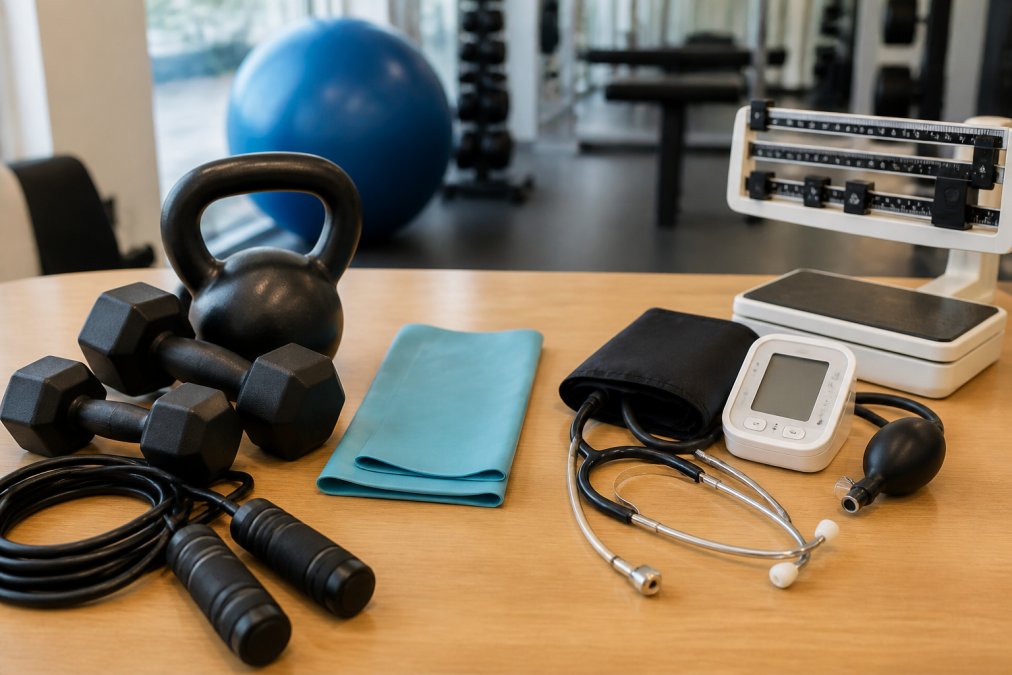
Resistance bands are the single most versatile tool for home rehab. They provide accommodating resistance, meaning load increases as the muscle reaches its strongest point. This is gentler on inflamed joints than free weights. Light, medium, and heavy bands cover the full progression from acute recovery through functional movement restoration.
A stability ball supports core stability work without compressive spinal loading. Prone holds, wall squats, and supported bridges are all accessible without additional equipment.
A foam roller addresses soft tissue quality and helps manage inflammation in surrounding musculature. Spend 5-10 minutes on the foam roller before each session targeting tissues adjacent to the injury site, not directly on it.
For those managing chronic pain or post-surgical recovery, the National Institutes of Health's pain management resource library provides clinically grounded guidance on low-impact movement modalities that complement home-based exercise.
How to Apply Progressive Overload After Injury
Progressive overload after injury is the systematic, incremental increase in training demand to drive tissue adaptation without exceeding the tissue's current capacity. Getting it wrong is the primary reason people plateau or re-injure.
The standard approach of adding weight each week does not translate directly to rehabilitation. Injured tissue follows a different adaptation curve. Connective tissue adapts more slowly than muscle. Increasing load faster than connective tissue can remodel is a reliable path back to acute injury.
A more appropriate framework for progressive overload after injury:
Phase | Primary Variable to Progress | Secondary Variable | Frequency |
Early rehab (weeks 1-3) | Range of motion | Repetition volume | 3-4x/week |
Mid rehab (weeks 4-8) | Repetition volume | Load (resistance) | 3-4x/week |
Late rehab (weeks 9-16) | Load | Intensity (tempo, complexity) | 4-5x/week |
Return to activity | Functional movement specificity | Sport/activity load | As tolerated |
Progress one variable at a time. Increasing both load and volume simultaneously creates ambiguity when symptoms flare.
Tracking Progress Metrics During Rehab
Tracking progress metrics during rehab is non-negotiable for objective evidence of recovery. Subjective pain ratings fluctuate with sleep, stress, and hydration. Objective metrics don't.
Metrics worth tracking consistently:
Pain rating (0-10 scale): Record before, during, and 24 hours after each session. A post-exercise rating above 3/10 that persists into the next day signals excessive load.
Range of motion: Measure with a goniometer or photograph comparison at weekly intervals.
Repetition quality: Note when form breaks down during a set. This is your current capacity ceiling.
Swelling or joint warmth: Document any changes after sessions. Persistent swelling indicates the tissue is not tolerating current training volume.
Functional benchmarks: Can you perform specific daily tasks without pain? Track these weekly.
A simple training log is more useful than any app if it captures these five data points consistently.
Pro Tip Track your 24-hour post-session pain rating as rigorously as you track your lifts. A pattern of ratings above 3/10 the morning after training signals the load needs to come down.
How to Modify Lifting for Injury Without Losing Gains
Modifying lifting for injury does not mean abandoning strength development. It means redirecting training stimulus to structures that can tolerate load while protecting those that cannot.

The principle is training around the injury, not through it. A shoulder injury does not prevent lower-body or core training. A knee injury does not prevent upper-body hypertrophy work. Maintaining systemic training stimulus reduces overall atrophy, preserves metabolic conditioning, and supports the psychological continuity of training identity.
Specific modification strategies include reducing range of motion with partial movements, switching to unilateral work, using isometric holds, and adjusting loading angle. The goal is to maintain as much training volume and frequency as the injury permits, applied intelligently to what can be loaded safely.
Core Stability and Muscle Balance During Recovery
Core stability during rehab is about protecting the spine and creating the proximal stability that allows distal movement to occur safely. Almost every orthopedic injury benefits from focused core stability work.
Muscle imbalances are both a cause and consequence of injury. Rehabilitation is the ideal time to identify and address these imbalances systematically. Effective core work includes dead bugs, bird dogs, Pallof press variations, single-leg stance progressions, and lateral band walks.
Watch Out Avoid sit-ups and crunches during spinal injury recovery. These create significant compressive load on lumbar discs. Plank variations and dead bugs provide superior core activation with far less spinal compression.
Signs of Overtraining During Rehab You Should Not Ignore
Overtraining during rehabilitation is easier to fall into than during normal training cycles, because the drive to recover quickly overrides the instinct to back off. Recognizing the signs early prevents minor setbacks from becoming full regressions.
Signs that demand an immediate load reduction:
Persistent joint swelling that does not resolve within 24 hours of a session
Sleep disruption or increased fatigue that doesn't track with life stress
Mood changes, specifically increased irritability or low motivation
Strength regression across two consecutive sessions without explanation
Pain that spreads beyond the original injury site
Loss of range of motion that was previously achieved
A single bad session is not overtraining. A pattern across 3-5 days is. Sustained symptom patterns require a genuine programming adjustment.
Key Takeaway The goal of rehab training is consistent forward progress over months, not maximal effort each session. A week of reduced load costs far less than a re-injury that resets the clock by 6-8 weeks.
Nutrition and Psychological Readiness for Returning to Training
Recovery does not happen only in the gym. Nutrition and psychological readiness are two factors that consistently determine the speed and completeness of recovery, yet rarely appear in training guides.
Nutrition That Supports Tissue Repair
Nutrition for tissue repair is an active intervention. The raw materials for collagen synthesis, muscle protein turnover, and inflammation regulation all come from diet.
Key nutritional priorities during rehabilitation include adequate protein intake to support muscle protein synthesis and limit atrophy, vitamin C for collagen synthesis, omega-3 fatty acids to support inflammation resolution, zinc and magnesium for tissue repair and neuromuscular function, and consistent hydration. Connective tissue is approximately 70% water; chronic underhydration impairs the mechanical properties of tendons and cartilage.
According to the Academy of Nutrition and Dietetics' position on sports nutrition, nutritional support during injury recovery is a distinct clinical priority that differs meaningfully from general athletic nutrition.
Psychological Readiness for Return to Sport
Psychological readiness for return to sport is a genuine clinical construct. Fear of re-injury is one of the most consistent predictors of poor outcomes after rehabilitation, even when physical recovery is objectively complete.
Treat psychological readiness as a spectrum, not binary. Clients who work through graduated exposure, completing progressively more demanding movements in a controlled environment, consistently report higher confidence and lower anxiety at return to activity.
Practical strategies include setting process goals rather than outcome goals, graduated exposure to movements that feel threatening, normalizing the non-linear timeline, and identifying the specific moment of hesitation. The British Journal of Sports Medicine's research on psychological readiness scales documents that athletes who score low on psychological readiness measures at discharge from physical therapy are significantly more likely to report re-injury within twelve months, regardless of physical test outcomes.
When to Consult a Professional About Strength Training After Injury
Most people wait too long to seek professional guidance, then seek it reactively after a setback. Consult a professional before you begin strength training after any significant injury, not after you've already tried and hit a wall.
Specific situations requiring professional clinical guidance include any injury involving surgical intervention or immobilization, injuries with a neurological component, chronic pain persisting more than 12 weeks, injuries re-aggravated more than once, significant muscle atrophy, and any cardiac, metabolic, or systemic condition affecting exercise tolerance.
Physical therapists provide diagnostic assessment and clinical treatment. A qualified fitness professional with a clinical background provides the bridge between clinical discharge and full return to activity. That gap is where most re-injuries happen.
A re-injury typically sets recovery back by weeks to months. The cost-benefit calculation of professional guidance is not close.
Recovery Stage | Primary Focus | Key Risk to Manage |
Acute (0-2 weeks) | Pain and inflammation control | Overloading healing tissue |
Sub-acute (2-6 weeks) | Range of motion and light loading | Moving too fast, too soon |
Remodeling (6-16 weeks) | Progressive strength and stability | Muscle imbalances and compensation |
Return to activity (16+ weeks) | Functional movement and load specificity | Psychological hesitation and re-injury fear |
This framework is a general guide. Individual timelines vary significantly based on injury type, severity, age, and training history.
Rebuilding strength after injury is one of the more technically demanding things a person can do in a training context. The margin for error is smaller, the variables more numerous, and the consequences of getting it wrong more significant than in standard training. Working with someone who has a clinical background and direct experience with post-injury populations is the most reliable way to close that margin. Julie McGrath's integrated approach, combining corrective exercise prescription, nutritional guidance, and clinical experience developed through work with the NFL Rehab program and neurological recovery cases, is designed specifically for this. Contact Now to start building a recovery protocol that matches your actual injury, your history, and your goals.
Frequently Asked Questions
How long should I wait to work out after an injury?
There is no single timeline that applies to every orthopedic injury. Acute injuries typically require a period of relative rest while inflammation settles, which can range from a few days to several weeks depending on severity. The safest approach is to get clinical guidance before resuming any loading. A qualified professional can assess your range of motion, joint stability, and pain levels to determine when low-impact movement is appropriate and how to progress from there.
How do I know if my pain is 'good' or 'bad' during rehab?
Mild muscle fatigue or a 2-3 out of 10 discomfort during controlled movement is generally considered acceptable during rehabilitation. Pain that is sharp, shooting, or worsens during or after exercise is a signal to stop and reassess. Swelling, joint instability, or pain that lingers more than 24 hours after a session suggests the load exceeded what your connective tissue and recovering structures could handle. Always report new or escalating symptoms to your physical therapist or coach.
Can I lift weights safely with a knee injury?
Strength training after a knee injury is possible, but the exercise selection, range of motion, and load must be carefully modified. Avoiding high-impact movements and deep knee flexion in early recovery is standard practice. Seated leg presses at a partial range, straight-leg raises, and resistance band work around the hip and glute complex can maintain muscle activation while protecting the joint. A corrective exercise specialist can prescribe a program that addresses muscle imbalances contributing to the injury.
What role does corrective exercise play in injury recovery?
Corrective exercise addresses the movement dysfunctions and strength deficits that either caused the injury or developed because of it. Rather than general fitness training, it targets specific muscle imbalances, improves proprioception, and restores functional movement patterns. This approach reduces the risk of re-injury and builds a structural foundation for returning to higher-intensity activity. It bridges the gap between physical therapy discharge and full return to training, which is a phase many rehabilitation programs leave unaddressed.
Contact Now
This article was written using GrandRanker

Comments